
The Khyber Centre for the Arts has an impressive 125 year history of use as a space for public presentation and social interaction.  It was originally erected as the Church of England Institute Building in 1888, commissioned by Bishop Hibbert Binney and designed by architect Henry Busch in an eclectic Victorian style with strong Gothic Revival influences. Other buildings designed by Busch in Halifax include the Halifax Academy (NSCAD Academy Building) and the Halifax Public Gardens Bandstand. Originally the building hosted a library, gym, women’s auxiliary, billiards hall, smoking room, and lecture hall. All kept tidy by a custodian housed in the top floor of the building. The Church of England Institute Building closed its doors in the 1940’s after being a well-known hostel for many Naval Officers serving in WWII. The Khyber Arts Society (anchor tenants of the Khyber building), grew out of various progressive groups and organizations that began to use the then-neglected building in the 60?s, 70?s, 80?s, and into the 90’s. Such groups included a refugee clinic, youth clinic, health food store, pottery studio, the city’s first gay social hub (the Turret Club, Gay Alliance for Equality), the Heritage Trust, Atlantic Film Co-op, Wormwood Cinema, and the Khyber Café. The building was unofficially renamed the Khyber Building by the public in the 1970’s when the Khyber Cafe opened on the ground floor.

Turret Club drag show
Eventually a more formal administrative body evolved to handle the growing number of cultural projects. In 1994, the Khyber was established as an arts facility by the No Money Down Cultural Society, a group of artists who negotiated an agreement with the City of Halifax to maintain the city-owned and then unoccupied building in exchange for permission to hold art exhibitions and operate a dance club. In 1995, when the building was slated for sale by the regional municipality

Gerald Ferguson installation from 1995
The Heritage Trust of Nova Scotia moved it’s office into the building to help preserve the property. Heritage Trust of Nova Scotia and the Arts Centre Project Society (soon to be Khyber Arts Society) collaborated to launch a widespread campaign to keep the Khyber public and to secure a long-term lease. With the support of several members of Halifax City Council, the Khyber Arts Society was promised a three-year lease at $1 per year. However, due to the expansion of the adjoining Neptune Theatre, the Khyber Building needed extensive structural renovations, and the Society was forced to temporarily relocate. As a result of these complications, the deal fell through.
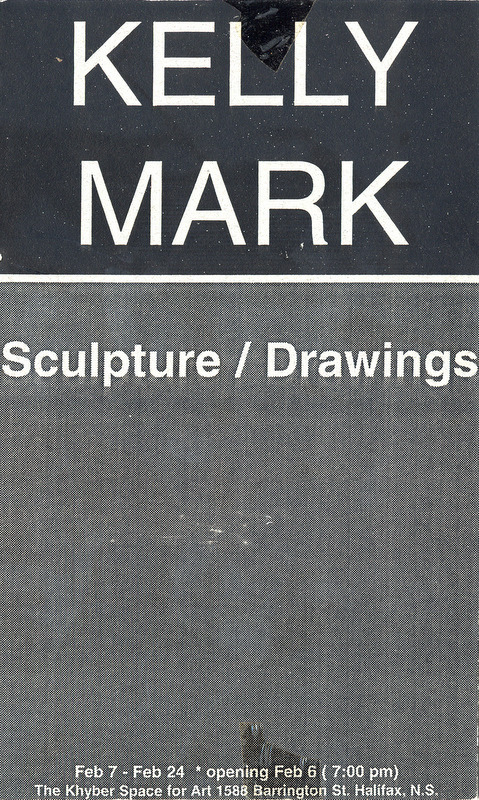
A year later, in 1996, the Khyber Arts Society signed a new five-year renewable lease with the City of Halifax to occupy the Khyber Building. The agreement included restoration and business plans that provided the Society with reduced rent for the first four years in exchange for ongoing volunteer labour to restore the building. During this phase of renovations, the Society obtained a loan from the Heritage Trust of Nova Scotia and fundraised enough money not only to self-finance the renovations, but also to purchase bar equipment.
In March 1998, after obtaining a liquor license, the Khyber Club opened to the public, and quickly re-established itself as a meeting place for visual artists and as an important venue for Halifax’s strong music scene. Since then, the Khyber has been host to many artists and musicians who have gone on to gain international recognition. Such artists as Emily Vey Duke, Shary Boyle, Kelly Mark, Joel Plaskett, Classified, and Buck 65 all spent formative years at the Khyber. Currently the Khyber Arts Society leases space from HRM on the second floor of the building while renting additional space on the second and third floors on an event-by-event basis.

Joel Plaskett playing in the Turret Room
The Khyber Board of Directors is made up of professional artists and other professionals from the community. The Khyber Centre for the Arts continues to be the heart of Halifax’s artistic cultural scene and a place for artists and non-artists to meet, explore career potentials, and to share with the larger community. The Khyber helps keep our creative people busy in the community.
Building Chronology:
1888
- Cornerstone laid, Church of England Institute
- Estimated cost of building: $16,000; $8,000 borrowed on a mortgage
- Main Floor – Committee Room, Reading Room, Library, and gymnasium
- Second Floor – Council Rooms, Lecture Hall
- Third Floor – Billiard Room, Smoking Parlour, custodian’s apartment, kitchen
- Originally commissioned under Bishop Hibbert Binney
- Designed by architect Henry F. Busch in a Victorian influenced, Gothic Revival style; featuring ornate brick and sandstone facade, dormered mansard roof, oriel window and spired turret supported by Corinthian column
1890s
- Anna Leonowens lectures at the Institute about her time at the Siamese court of Rama IV
- Electric lighting installed
1900s
- Membership includes 166 women, 258 men
- Church Work magazine installed at the Institute
- Reading Room sign: “Talking, whistling, or other noises not permitted.”
- Increasing financial concerns, looming debt
- Reading Room moves to middle floor and expanded to accommodate 84 papers, periodicals, and magazines
- Gymnasium dressing room enlarged; showers and baths installed
1910s
- Boy Scouts of Nova Scotia begins at the Institute
- Women’s Auxiliary begins Girl Guides
- Fire damages much of upper story; Institute closes temporarily as a result
- “Burn the Mortgage” campaign; final mortgage payment; clear of debt upon Institute’s reopening
- George Wright perished on Titanic; left Institute $1000 legacy
1920s
- Gymnasium abandoned and replaced with offices
- Fundraising gala held, raised $556
1930s
- Squash court opens
1940s
- Space leased to the Naval Officer’s Club for the duration of WWII
- VE-Day Riots cause damage to windows
- Explosion in custodian’s quarters
- Oil burning furnace installed
1950s
- Church of England Institute attempts to find a buyer for the building with no success
1960s
- Naval Fire Fighters’ Association purchases the building
- Current civic address is issued: 1588 Barrington Street
1970s
- Fire Fighters’ Association moves out; sells building to Kathleen Stevens Zwicker
- Bean Sprout health food store moves into main floor of building
- Sanpaka restaurant located on top floor
- Halifax Youth Clinic opens
- GAE (Gay Alliance for Equality) office on middle floor; opens the Turret Club, Halifax’s second gay bar (Green Lantern Building across the street hosting the first)
- Alternate Bookstore, the first gay bookstore east of Montreal, is located on the 2nd floor
- Magical Books and Letters opens on the main floor North Room
- Vitabox is later opened in the same space
- Turret Club hosts boisterous Halloween event
1980s
- Bean Sprout’s Amin Nasr buys building
- Building formally recognized as a Nova Scotia Heritage Property in 1981
- Turret Club closes (later reopens in new location as Rumours)
- Wormwood Cinema opens on the third floor (a 93-seat theatre)
- Atlantic Filmmakers Co-op shares top floor with Wormwood
- Metropolitan Immigrant Settlement Association (MISA) is on the second floor
- Khyber Café opens, has kosher bakery
- Kara’s Salon moves into main floor, North room
- Building bought by the City of Halifax in 1986
- Bean Sprout moves out; Khyber Café moves into that space
- Ballet studio using back space
- Wormwood and AFCOOP leave the building
1990s
- Kara’s moves out
- DJs at the Khyber Café; artists squatting on third floor
- No Money Down Cultural Society formed (active artists in the building)
- Chestnut Tree Theatre
- Heritage Trust of Nova Scotia moves into first floor North Room
- Neptune uses building for rehearsals
- Building established as an art centre by Halifax City Council
- The Halifax Arts Centre Project is formed – name changed to The Khyber Arts Society and a lease is signed with the city
- Renovations, 1996
- Khyber Club bar; sells cotton candy
2000s
- Building listed as a Canadian Historic Place in 2005
- Save the Khyber! Campaign
- Khyber report used as a template to rehabilitate other buildings
- Windows replaced by the city – Garry Neill Kennedy’s And Still Counting installation
- City Council commits renewed support for the building as a “cultural incubator” for the city
2010s
- Khy-Bar opened
- Carbon Arc Cinema operates screening on 3rd floor